
2026 World Cup Group G: Analysis, Odds and Prediction (Belgium, Egypt, Iran, New Zealand)
Belgium are favourites but weakened by Lukaku's fragility and the age of their golden generation, Egypt are armed with a Salah–Marmoush duo capable of turning everything upside down, Iran are without Azmoun amid a tense political backdrop, and New Zealand are back sixteen years after 2010: Group G at the 2026 World Cup hides more uncertainties than meets the eye. Team-by-team analysis, odds and our verdict.
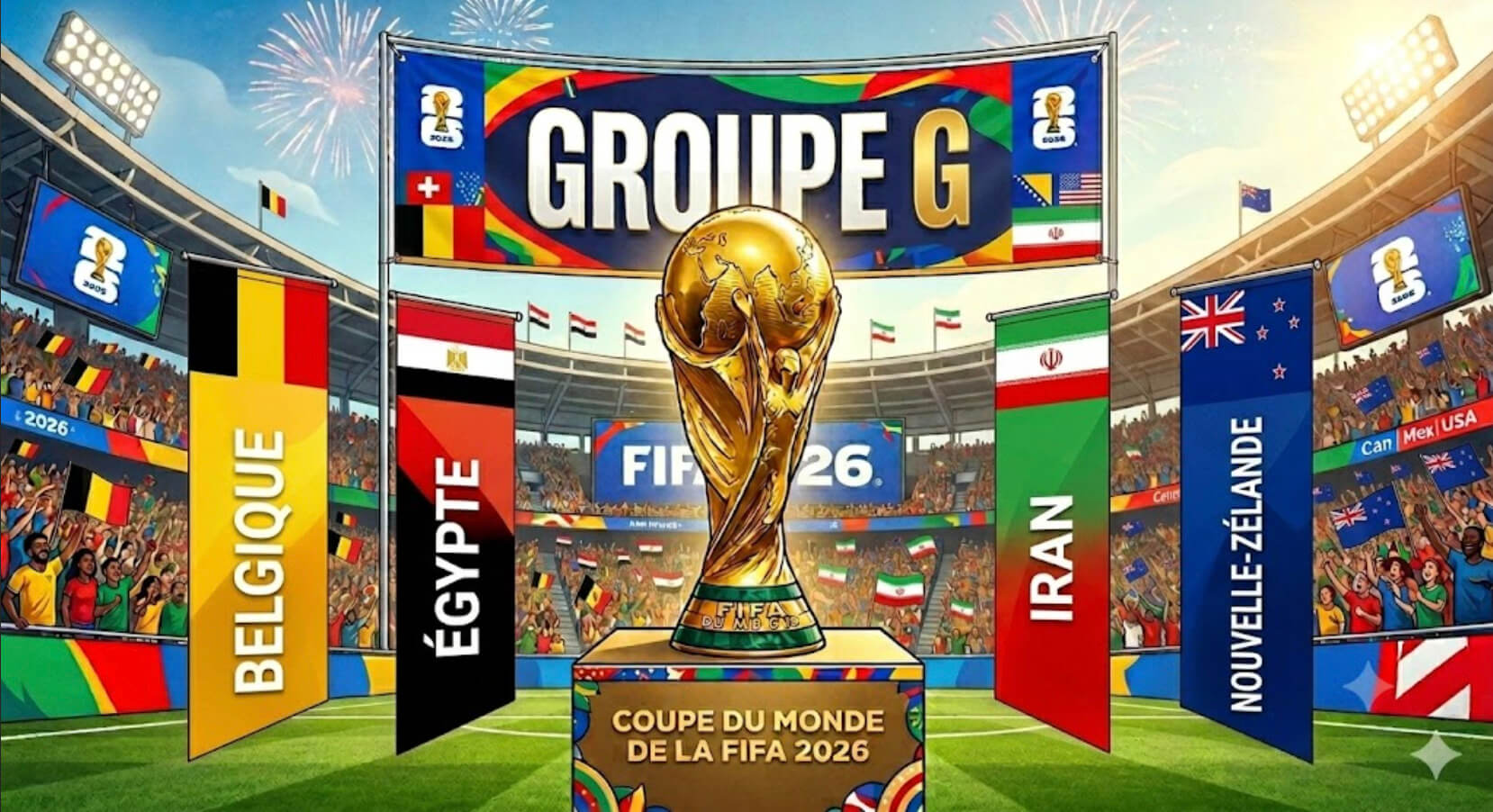
🌎 Overview
Group G at the 2026 World Cup looks neatly ranked on paper — but warning signs are flashing on Belgium's side. The Red Devils arrive at what is probably the last World Cup for their golden generation with Lukaku out of form, De Bruyne and Witsel at the end of the road, and the still-painful memory of a group-stage exit at Qatar 2022. Egypt, driven by a Mohamed Salah who may be playing his final World Cup after his emotional farewell to Liverpool, have the talent to shake up the pecking order. Iran, the first Asian nation to qualify for the tournament with seven wins from ten qualifying matches, arrive without Sardar Azmoun — left out for political reasons — and under unusual geopolitical pressure, with their matches in Seattle taking place against a backdrop of US–Iranian tensions. New Zealand, ranked 85th by FIFA, are contesting their third World Cup in history after 1982 and 2010 — the latter edition still remembered for three undefeated draws. The matches run from 15 to 27 June 2026 on the west coast: Los Angeles, Seattle and Vancouver.
🇧🇪 Belgium — the end of an era for a generation looking to bow out in style
Third in 2018, eliminated in the group stage in 2022: Belgium go into this World Cup as a last chance for the most talented generation in their history.
The context
It's Belgium's 15th World Cup, and probably the last for De Bruyne (34), Lukaku (33), Witsel (37) and Meunier (34). Rudi Garcia, appointed head coach in 2025, unveiled his squad on 15 May with one major question: Lukaku is healthy but out of form, after only 60 minutes of playing time this season at Napoli. Garcia himself stated: "He's recovered but he's out of form. Our challenge is to get him back into shape." Another notable absence: Loïs Openda, the RB Leipzig striker left out because he is "a victim of barely playing anymore at Juventus" — replaced by Matías Fernández-Pardo (Lille), a first call-up after a strong Ligue 1 season. Zeno Debast is on the list despite a recent quadriceps tear.
Key players
Thibaut Courtois (Real Madrid): world-class goalkeeper, 199 cm, an essential return for the Red Devils. Lost from the start of the 2022 fiasco through injury, he this time represents stability between the posts.
Kevin De Bruyne (Napoli, 34): the creative genius, central piece of the system despite his age. Under Rudi Garcia, he is expected to take on the role of vice-captain, with Youri Tielemans designated as captain.
Jérémy Doku (Manchester City): speed and incisiveness. The former Rennes man is the most eagerly awaited player on this list, capable of unlocking the best-organised defences with a single burst.
Charles De Ketelaere (Atalanta): attacking midfielder in great form at Bergamo, representative of the new generation.
Amadou Onana (Aston Villa) & Youri Tielemans (Aston Villa): the double pivot that structures the midfield.
Romelu Lukaku (Napoli, 89 international goals): the all-time top scorer in Red Devils history, present despite an almost blank season.
Strengths and weaknesses
Strengths: on paper one of the most complete squads in the group — Courtois in goal, De Bruyne pulling the strings, Doku as the spark, an experienced defence with Castagne, Theate and De Cuyper. Garcia has also made some renewal picks (Fernández-Pardo, Moreira, Seys, all aged 21) who can bring freshness. Weaknesses: the ageing core is a reality — Witsel at 37 is the most exposed figure. Lukaku out of form and Loïs Openda absent deprive the Red Devils of their natural in-form goalscorer. Belgium have not gone beyond the quarter-finals since 2018, and the 2022 elimination still weighs heavily.
🇪🇬 Egypt — the African giant with Salah for one last dance
Mohamed Salah will play at the 2026 World Cup what may be his final World Cup after his emotional farewell to Liverpool. He arrives more motivated than ever to write a historic chapter with the Pharaohs.
The context
It's Egypt's fourth World Cup (1934, 1990, 2018, 2026). Qualification was managed in controlled fashion under Hossam Hassan, with 13 points from five matches and a solid first place in their African group. Coach Hossam Hassan builds his 4-2-3-1 around Salah, given a free role behind the centre forward, with a double pivot to protect the defence. Egypt open their tournament on 15 June against Belgium at the SoFi Stadium in Los Angeles — the most anticipated fixture of the group.
Key players
Mohamed Salah (Liverpool → club to be confirmed, 33): captain and undisputed leader, more than 60 international goals and the motivation of a player nearing the end of his international career. His Liverpool exit was marked by emotional farewells — he arrives at the World Cup eager to leave a lasting mark.
Omar Marmoush (Manchester City): Salah's attacking partner, well-versed in the Premier League. His strong club connection with Salah directly enhances their understanding at international level.
Mostafa Mohamed (FC Nantes): the centre forward expected to complete the attacking trio, a regular in Ligue 1.
Ahmed Sayed Zizo: experienced winger, an option off the bench.
Alireza Beiranvand — not to be confused: Mohamed El Shenawy remains the Pharaohs' first-choice goalkeeper.
Strengths and weaknesses
Strengths: the Salah–Marmoush duo is the best attacking pairing in the group on paper. The Pharaohs' collective cohesion is real — a regular AFCON presence, a controlled qualification campaign, experience at major events. Defensive solidity in qualifying (few goals conceded) is a positive signal. Weaknesses: squad depth remains inferior to Belgium's. Dependence on Salah is structural: if the captain is neutralised or injured, attacking resources shrink considerably. Egypt have never gone past the first round of a World Cup — the psychological weight of that record will be present.
🇮🇷 Iran — the Asian competitor in a tense atmosphere
Iran are contesting their 7th World Cup and their 4th in a row. They arrive with an unprecedented context, both on and off the pitch.
The context
The first Asian nation to qualify for the tournament, Iran topped their AFC group with 7 wins in 10 matches. Under Amir Ghalenoei, Team Melli dominated qualifying. But the group arrives marked by the absence of its second offensive star: Sardar Azmoun (31, 57 goals in 91 caps) was left off the final list after missing the March friendlies, due to allegations of disloyalty to the government. Iran will also have to navigate a sensitive geopolitical context: their matches in Seattle sparked controversy after the US decision to designate one of them a "pride match," which the Iranian and Egyptian federations officially refused.
Key players
Mehdi Taremi (Olympiacos, 33): de facto captain since Azmoun's removal, more than 100 caps, a third World Cup. He remains the team's only world-class attacking star and will have to shoulder more responsibility.
Alireza Jahanbakhsh (Dender): experienced winger, creative option on the flanks, a dressing-room leader. Captain during the decisive qualifier against Uzbekistan.
Alireza Beiranvand: veteran goalkeeper, one of Team Melli's historic pillars.
Dennis Eckert Ayensa (Standard, Belgium): the dual-nationality striker who represents the influence of the diaspora on the Iranian squad.
Strengths and weaknesses
Strengths: a compact, disciplined defensive block, remarkable physical intensity in duels, efficiency from set pieces and the experience of four consecutive World Cups. The opening match against New Zealand on 16 June in Los Angeles is a direct opportunity to launch the campaign. Weaknesses: Azmoun's absence leaves Taremi as the only genuine international-level scorer — the gap is hard to fill with the five strikers called up to replace him. The geopolitical pressure and the context surrounding the Seattle matches add an instability that is difficult to quantify. Iran have never reached the round of 16 in seven appearances.
🇳🇿 New Zealand — the All Whites return, sixteen years after their unbeaten World Cup
In 2010, New Zealand were the only unbeaten team at the World Cup — three draws against Slovakia, Italy and Paraguay. In 2026, they want to matter again.
The context
It's New Zealand's third World Cup (1982, 2010, 2026). Qualification in the OFC zone was emphatic: 29 goals scored, just 1 conceded, five straight wins under Darren Bazeley, appointed head coach in July 2023 after a career with the youth teams (U20 finalists in 2015, 2017 and 2023). The 26-man squad announced on 13 May contains a curiosity: Tommy Smith, called up while at Braintree Town (English regional league) at the age of 35. Darren Bazeley has lined up a compact, physical 4-2-3-1 built to withstand pressure and strike on the transition.
Key players
Chris Wood (Nottingham Forest, 34): captain, all-time top scorer in New Zealand history, the third New Zealand captain at a World Cup after Sumner (1982) and Nelsen (2010). The attack rests almost entirely on him.
Ben Old (Saint-Étienne): the only Saint-Étienne player in the squad, attacking midfielder and representative of the up-and-coming generation.
Clayton Lewis: midfielder, one of the most experienced in the group, the playmaker expected to feed Wood.
Liberato Cacace: left back, the most European of the New Zealand defenders.
Strengths and weaknesses
Strengths: a unique collective cohesion — players who have known each other since the youth teams — a well-drilled defensive organisation and the competitor mentality inherited from 2010. In a tough group, the All Whites have the ability to keep matches tight and produce a surprise from a set piece or counter-attack with Wood. Weaknesses: outside of Wood, attacking resources are very limited at world level. Most of the squad play in modest leagues — the level of preparation is not comparable to that of Belgium or Egypt. New Zealand's first two World Cups (1982: 3 defeats; 2010: 3 draws) never produced a win.
📊 The odds (for reference)
The odds below reflect the bookmakers' consensus as the tournament approaches; they shift constantly. What matters: the hierarchy rather than the exact figures.
Rank 1: 🇧🇪 Belgium → Group winner: 1.57 | Qualification: 1.15
Rank 2: 🇪🇬 Egypt → Group winner: 5.10 | Qualification: 1.60
Rank 3: 🇮🇷 Iran → Group winner: 9.00 | Qualification: 2.20
Rank 4: 🇳🇿 New Zealand → Group winner: 50.00 | Qualification: 8.00
Belgium at 1.57 remain clear favourites but well short of the crushing dominance of other top seeds — a sign that bookmakers are pricing in their uncertainties. Egypt at 5.10 with qualification odds at 1.60 reflects recognition of the Salah–Marmoush threat. Iran at 9.00 remain a credible outsider, especially if the opening match against New Zealand is won.
📍 Schedule and venues
Group G matches run from 15 to 27 June 2026 on the American west coast and in Canada. Times are in Paris time (CEST); the stadiums carry neutral names during the competition.
Matchday 1
Sun. 15 June — Belgium 🆚 Egypt — SoFi Stadium, Los Angeles — time TBC
Mon. 16 June — Iran 🆚 New Zealand — SoFi Stadium, Los Angeles — 03:00
Matchday 2
Sat. 21 June — Belgium 🆚 Iran — Lumen Field, Seattle — time TBC
Sat. 21 June — Egypt 🆚 New Zealand — BC Place, Vancouver — time TBC
Matchday 3 (simultaneous kick-offs)
Sat. June 27 — Belgium 🆚 New Zealand — BC Place, Vancouver — time to be confirmed
Sat. June 27 — Egypt 🆚 Iran — Lumen Field, Seattle — time to be confirmed
Quick betting angle: the opening clash Belgium–Egypt (June 15, Los Angeles) is the headline fixture of the group. A Belgium side with an out-of-form Lukaku facing a Salah–Marmoush duo at the peak of their powers — the double chance markets and match odds deserve a thorough analysis before kick-off.
🏆 Our verdict
Likely winner: 🥇 Belgium. The most complete squad in the group on paper, Courtois unbeatable between the posts, De Bruyne and Doku capable of making the difference: the Red Devils should finish top despite their uncertainties — but without the usual composure of a dominant favourite.
Second favourite: 🥈 Egypt. Salah more motivated than ever for his last World Cup dance, Marmoush in Premier League form and a solid collective structure: the Pharaohs are the most dangerous opponents for Belgium and the natural favourites for second place.
Credible outsider: 🇮🇷 Iran. A manageable opening match against New Zealand, proven defensive solidity and seven World Cups of experience: Team Melli can spring a surprise and aim for their first ever historic round of 16.
The verdict, in one sentence: Belgium should finish first despite their doubts; Egypt and Iran will battle it out for second place in a decisive Egypt–Iran clash on June 27 in Seattle that promises to be electric, while New Zealand are playing for a memorable point.
All our analysis and predictions on Bet Ninja.
🔞 Adults only. Predictions are statistical analyses and do not guarantee any winnings. Gambling carries risks: debt, isolation, addiction. For help, call 09 74 75 13 13 (standard-rate call) — Joueurs Info Service.